
Choose the Right Green County History Source
Green County's records run deep. The county dates to 1793, and the clerk reports that the courthouse holds most legal documents from 1795 forward. Online coverage varies by instrument and year. Step one is placing the suspected transfer in the right collection. Recent former owners often surface in eCCLIX. Nineteenth-century owners usually take deed books, tax lists, court books, or library microfilm.
| Source | Years It Covers | Where Held | What It Shows |
|---|---|---|---|
| eCCLIX land index | Index-only real estate from 1993; indexed and imaged filings described from August 1995, with most online images from January 2004 | Online through the Green County Clerk | Grantor, grantee, recording reference, instrument type, and available image |
| Courthouse legal records | Most categories from 1795 to present | Green County Clerk, 203 W Court Street | Deeds, mortgages, liens, releases, wills, assignments, and related instruments |
| Library deeds and tax lists | Deeds 1793-1888; tax lists beginning in 1795 | Green County Public Library genealogy room | Earlier names, annual landholder clues, and book references |
| Plats, surveys, and court material | Depends on the cited book, case, or collection | Clerk, circuit clerk, KDLA, and library | Lot identity, tract changes, estates, boundaries, and litigation |
Start with the Green County Clerk when you know a recording date or a book and page. An early, uncertain date is harder. The Green County Public Library genealogy collection can supply a surname, a tax year, a newspaper date, or a deed-book lead. Treat tax-list and census entries as clues only. They suggest presence, not ownership.
Reconcile the Clerk's Online Date Ranges
The clerk's land-record and legal-record pages describe overlapping but different categories. One reports indexed and imaged real-estate filings since August 1995, security agreements since June 1999, and index-only real estate since 1993. An archive effort aims to improve images back to January 1990. The other page gives a different window. It says most instrument images run from January 2004 to the present. Don't collapse these into one universal cutoff.
Test your exact instrument in eCCLIX. Match the type and the date. If an index entry lacks an image, ask the clerk for the cited book, page, or instrument. A missing image doesn't mean the deed went unrecorded. Accounts or payment requirements may apply online. Courthouse viewing remains the practical fallback.
Reconstruct the Green County Deed Chain
Start from a verified parcel identity. Street names change. So do rural route descriptions. The deed's tract wording, acreage, subdivision lot, and prior deed reference form stronger bridges between generations of Green County records than any address ever will, and a PVA map ID paired with the legal description makes the best anchor of all.
- Locate the newest recorded deed and note its grantee, grantor, execution and recording dates, instrument number or book/page, and prior-deed citation.
- Confirm that its legal description matches the same property, including acreage, exclusions, reservations, subdivision, lot, and plat references.
- Search the grantor as an earlier grantee. Repeat the comparison rather than assuming every deed involving that name concerns the same land.
- At the online limit, carry the last reliable book/page and party names to courthouse books, microfilm, KDLA, or the library collection.
- Grantor / grantee
- The conveying party and receiving party. Their legal capacities matter when an executor, trustee, guardian, or company officer signs.
- Chain of title
- The ordered succession of instruments affecting the same land, with gaps and conflicts identified rather than hidden.
- Legal description
- The deed language that identifies the tract. It outlasts many mailing-address and road-name changes.
Read Beyond the Names on Each Deed
A deed image can reveal execution and recording dates, consideration, marital status, tax stamps, exceptions, easements, the preparer, a return address, and the prior deed reference. Read past the names. A conveyance of an undivided interest may not transfer the whole parcel. Not every filing is an ordinary sale. Correction deeds, survivorship filings, affidavits, and estate instruments deserve their own labels.
Then search forward from each former owner's name. Look for a correction, mortgage release, easement release, restrictive covenant, assignment, lien, lis pendens, will, or probate-related instrument. Pull any record a deed references. If it says "subject to" a restriction or cites a plat, retrieve that too. A tidy sequence of owner names can still omit rights and burdens that matter to the property's history.
Match Old Tracts When Addresses Change
Old Green County deeds may cite a highway number, rural route, community, landmark, or metes-and-bounds tract instead of a modern street address. Keep each version intact. Don't force old wording into today's format. The legal description usually decides it. When several PVA search results share a road, compare map ID, acreage, improvement type, legal description, and deed reference before picking one.
Subdivision plats explain parent tracts, splits, merged parcels, and new lots. Historic names around Greensburg help too. Henry's Addition and the public-square area are promising leads. Still, local-history material is not legal evidence, so confirm any name against a recorded plat or deed before assigning it to a present parcel.
For a highway parcel, save both the road number and any local road name. Compare improvement type and acreage when several results share an access route. Never derive a boundary from parcel-ID formatting. Green County identifiers follow several patterns. The ID is a record key, not a legal code.
Extend the Ownership Trail Through Local Archives
The Green County Public Library's genealogy room reaches well past early deeds. County tax lists sit alongside federal Kentucky census material going back to 1810. Circuit order books, family files, cemetery sources, local histories, and newspapers round out the shelves. The newspapers span 1895 through June 2006. Any one of these can hand you the clue that cracks the next clerk search. It might be a spelling variant, an estate date, a sheriff-sale notice, a subdivision advertisement, or a community name long since changed.
Write down the title, issue or volume date, page, and collection reference for every find. Paper trails mislead. A newspaper item saying a family bought a farm does not convey the land. A census household proves residence, not title. Presence on a tax list can reflect assessment rather than a sale. So corroborate each lead against the actual deed, estate instrument, court order, or later recorded reference.
Litigation files can also patch a broken chain. Kentucky's archival Judicial Indexes permit searches by county, court, and party. Coverage runs incomplete, though, and spellings waver. Pull any case number and request the underlying file from the Green Circuit Court Clerk. Boundary and easement cases often hold surveys, plats, exhibits, and final orders. Estate, foreclosure, or partition files may name heirs and describe land, but they do not prove the recorded outcome.
Resolve Gaps Before Naming a Former Owner
A gap in the chain rarely means a missing deed. The cause may be a name change, initials, an alternate spelling, a trust or company name, marriage, probate, divorce, or an instrument indexed under a representative's capacity. Search both sides of the suspected date range. Use the exact subdivision, tract, and prior-deed references. When an LLC appears, Kentucky's Secretary of State search can clarify the entity's name and status; remember that an officer or registered agent is not automatically the landowner.
Keep non-owners out of the sequence. A mortgage lender, nominee, servicer, lienholder, or tax-certificate purchaser never belongs in the line of title. Delinquency alone does not transfer anything. For a foreclosure, trace the complaint or lis pendens, the judgment, the appraisal, the sale order, the commissioner notice, the sale result, the commissioner deed, and any later release or redemption. Only the recorded deed or another legally operative instrument decides whether ownership actually changed.
When certainty matters for a transaction, inheritance, or dispute, hire a professional title search. A do-it-yourself chronology makes fine house history and useful preparation, but it cannot promise marketable or insurable title.
Use Green County's Genealogy Room as a Bridge
The library's genealogy collection earns its keep. It shines the moment an online deed search hits a wall. Green County deeds from 1793 through 1888 sit in its holdings. So do tax lists from 1795. Federal Kentucky census material from 1810 is there too. The collection also holds newspapers spanning 1895 through June 2006, circuit order books, cemetery sources, and family histories. The library genealogy page is the public starting point. Use it for checking those older holdings and arranging a focused inquiry.
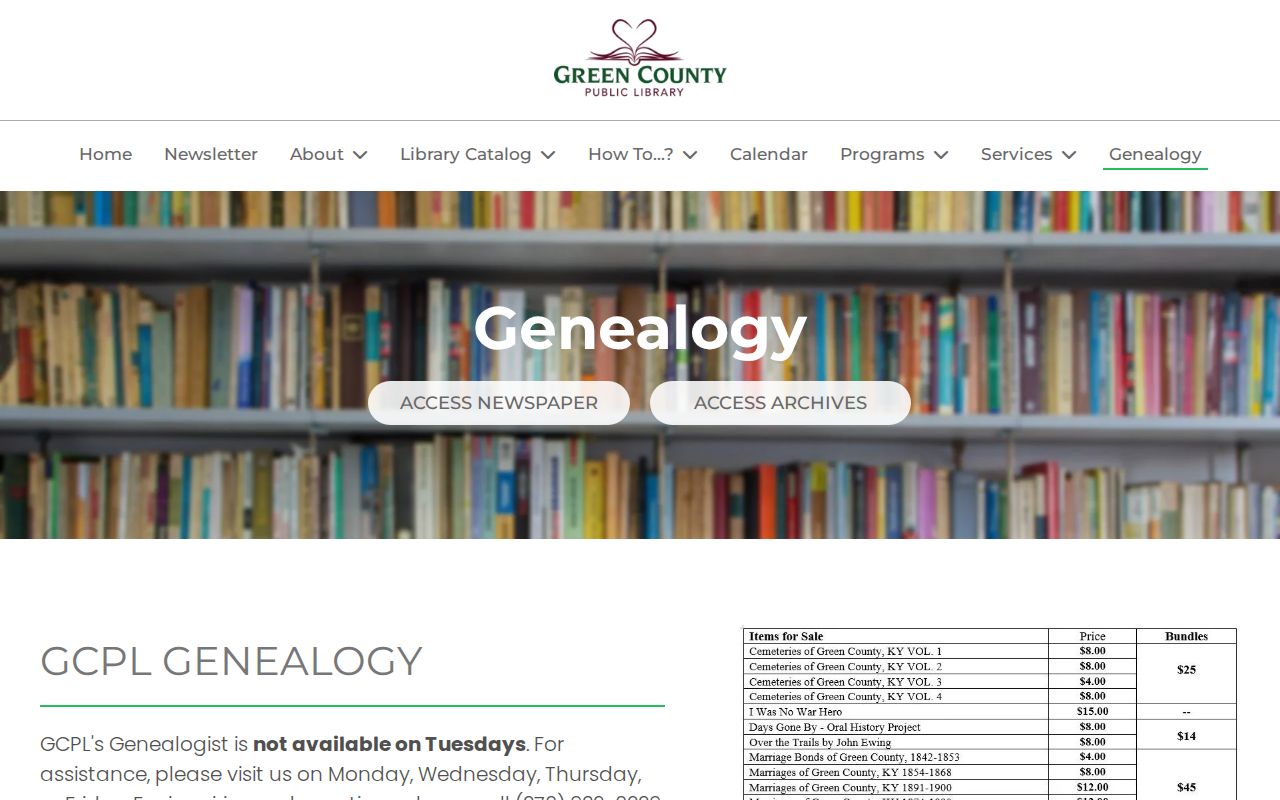
A collection view bridges an online cutoff, but names alone prove nothing. Every historical name still needs a tie to the subject tract through a deed, tax-list citation, court book, or other dated record.
Know Where Green County's Ownership Trail Changes Form
Green County was formed in 1793 from parts of Lincoln and Nelson counties. Research reaching past that date may cross county lines. Expect to consult predecessor-jurisdiction records, state land material, or patents. The courthouse and library can carry many searches deep into the nineteenth century. Yet no single database promises an unbroken chain.
Kentucky Judicial Indexes can surface a party or case number tied to an estate, boundary dispute, foreclosure, or equity case. The circuit clerk can say whether the underlying file remains onsite or sits under a retention schedule. Newspaper notices may yield a sale date or an estate name. Neither substitutes for the recorded outcome. For an opinion on marketable or insurable title, turn to a qualified title examiner. Or consult an attorney.
Use historical records responsibly. Former-owner research supports house history, genealogy, boundary work, and property diligence. Do not use owner names or addresses to track, threaten, or harass a living person; protected addresses may also be limited through Kentucky's Safe at Home program.