
What Green County Deed Records Show
Head to the Green County Clerk at 203 W Court Street in Greensburg. The office holds recorded land and legal instruments. The clerk is the county's recorder. A deed names the parties and describes the interest being conveyed. Reading the full image matters. Look for execution and recording dates, the legal description, consideration language, exceptions, reservations, prior references, and each signer's stated capacity. A trustee, executor, manager, or attorney-in-fact may sign in a role rather than as an ordinary seller. Check that capacity before assuming anything.
| Deed Type | What It Does | Common Use |
|---|---|---|
| Warranty deed | Conveys the stated interest with deed warranties | Ordinary arm's-length conveyance |
| Quitclaim deed | Conveys whatever interest the grantor holds, if any | Family or title-chain cleanup |
| Correction deed | Corrects an error in an earlier instrument | Name, description, or record-reference correction |
| Executor or trustee deed | Transfers in a stated fiduciary capacity | Estate or trust administration |
| Commissioner deed | Records a court-authorized sale outcome | Foreclosure or lien litigation |
Mortgages and liens get recorded beside deeds, but they do different jobs. A mortgage secures a debt. A release can discharge it. An easement grants access or another use without moving the whole parcel. A plat maps the recorded lots. Any careful Green County deed search follows each instrument a deed cites, since the newest document is rarely the only one affecting the land.
Green County eCCLIX Coverage
The clerk's land-record page links to eCCLIX. eCCLIX is the Kentucky County Clerk Indexing service. Green County real-estate filings are indexed and imaged back to August 1995. Index-only real estate reaches to 1993. An ongoing archive effort aims for images back to January 1990. A separate clerk statement puts most online instrument images from January 2004 forward. The dates cover different categories and image states. Test the exact year and instrument rather than forcing one cutoff on every record.
The eCCLIX landing page offers subscription access. Expect to search by grantor, grantee, document type, date, book and page, and instrument number. County users may also visit the clerk's office. More than 300,000 images are described as accessible through the service, but that total does not mean every Green County deed image is online.
Green County Instruments Beyond Deeds
The clerk's legal-record inventory is broad. Deeds, mortgages, mechanics liens, tax liens, assignments, releases, powers of attorney, wills, name changes, corporations, marriages, military discharges, and delinquent-property-tax records all appear. A title-focused search looks past the conveyance itself. Watch for later corrections, mortgage releases, easements, restrictions, subdivision plats, judgment liens, lis pendens, and estate instruments. Each category answers a narrower question.
The published Green County recording-fee schedule lists examples such as $50 for a deed, $46 for a correction deed, $80 for a mortgage, $50 for a plat, and $50 for an easement. An easement release runs $46. So do a mechanics lien and its release. Those figures are recording charges, not necessarily the cost of obtaining a copy, so check the live fee page before planning a filing.
Trace Green County Grantors and Grantees
A chain of title is the ordered sequence of recorded transfers for one parcel. Start with the newest deed. Match the legal description, acreage, or prior deed citation. A street address alone is weak because rural descriptions and road names change over time.
- Use the PVA map ID and current assessment name to locate the newest likely conveyance.
- Search that person or entity as grantee, then open the deed and copy its grantor and legal description.
- Search the grantor as grantee in the earlier period and confirm that the land description still matches.
- Follow any prior deed, plat, easement, correction, mortgage, release, probate, or commissioner reference.
- At the online limit, move to courthouse books, library holdings, KDLA, or microfilm.
- Grantor
- The party transferring the stated interest.
- Grantee
- The party receiving the stated interest.
- Chain of title
- The linked sequence of instruments for the same land.
- Book/page
- A volume and page locator for a recorded document.
- Instrument number
- A distinct filing identifier assigned by the recording system.
For a forward check, run the latest grantee's name as grantor to catch later transfers. Then review the liens and releases. The result is a parcel-specific sequence, not a list of people who share a name.
Older Green County Deed Books
Green County's offline record depth runs deep. The clerk dates most courthouse legal documents from 1795 to the present. The Green County Public Library genealogy collection reaches further. It holds Green County deeds from 1793 through 1888 with an index. Tax lists reach to 1795. Wills, circuit order books, census materials, newspapers, and microfilm round out the collection. Nothing leaves the building.
Review the library genealogy holdings before planning an older deed search in person.
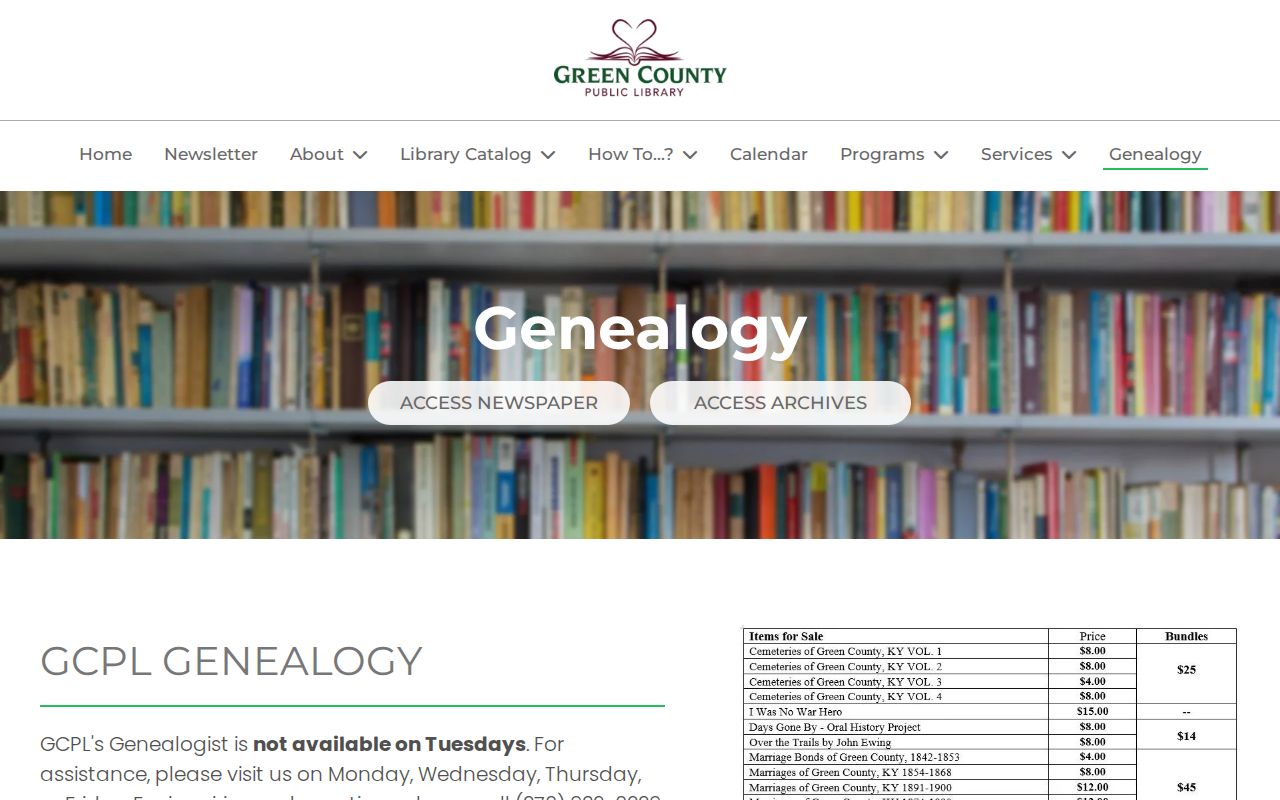
The collection can bridge an online image gap. A tax-list or newspaper item is only a lead. Names, dates, districts, and book references help, but return to the original deed book, since only the instrument records the conveyance.
Search Boundary-Era Green County Deeds
Green County formed in 1793. Lincoln and Nelson counties gave up the land. Older title work follows the jurisdiction that existed on the transaction date. A missing deed may sit in a parent county or a later boundary-era county rather than being lost from the Green County index. The KDLA county formation chart points the way.
Historic spelling matters too. Early sources used “Greensburgh” before the final letter fell away around 1818. Search Greensburg, Greensburgh, and likely variants. Preserve the original spelling in a citation instead of silently modernizing it.
Note: A historic tax list can identify a landholder or district, but only a deed or related instrument records the conveyance.
Green County Deed Fraud Alerts
The clerk offers a free deed-alert service. Property owners can register for the eCCLIX DOC ALERT service and receive notice whenever a matching deed or mortgage is recorded under their name or business name. Registration is simple. It asks whether the entry covers a business or trust, confirms the county, collects name components and confirmations, and uses an email address for delivering the alert.
DOC ALERT works as early warning only. It cannot block a filing or declare fraud. It also cannot replace review of the recorded image. If a notice arrives unexpectedly, compare the instrument at the clerk, preserve its locator, and consult qualified title or legal help as needed.
Request a Missing Green County Instrument
Sometimes eCCLIX shows no image. Then inspect the courthouse record. A narrow written request to the Green County Clerk works too. The clerk's Open Records Policy accepts hand delivery, mail, fax, or email. It calls for a written decision within five working days. Be specific. State the map ID, instrument type, grantor and grantee, date range, and the book/page or instrument number. Ask for an existing image or index entry, not a legal conclusion.
Fees are set out in the policy. Noncommercial paper copies run $0.50 each. Other recordings, discs, or tapes cost $5, with production and postage paid in advance. KRS 61.878 exemptions still apply. Forms requiring an original signature may need mail or in-person delivery. The request itself has several channels.
Give the clerk enough detail to tell the record apart from every other filing. The filing may sit under the same surname. Include deed type, approximate recording date, both parties when known, map ID, a legal-description clue, and an exact book/page from any cited source. Request cited plats, restrictions, easements, mortgages, or prior instruments separately. A narrow list keeps the chain clean. Each index entry then ties plainly to its image.
Obtain a Green County Deed Copy
Start with the online image when the instrument and year are covered. If access requires an eCCLIX subscription or the image is absent, use the courthouse counter or written request. The clerk is at 203 W Court Street, Greensburg, KY 42743, and can be reached at 270-932-5386, fax 270-932-6241, or jessicar.baker@ky.gov. Say whether an ordinary image or an office-certified copy is needed, and confirm the current copy charge before paying.
Keep the record locator with the copy. Book/page, instrument number, record type, recording date, grantor, grantee, and legal-description clue let another researcher reproduce the search. Compare the PVA assessment year separately if the owner names do not match.
Read the full deed rather than stopping at the index. Check execution and recording dates, fiduciary capacity, consideration wording, reservations, easements, prior-deed references, return address, preparer, notary block, and each legal-description exhibit. A deed conveying an undivided interest, correcting an older record, or carving land from a larger tract should not be summarized as a routine whole-parcel sale.
If a legal description says “subject to” another instrument, retrieve that record and any later release. If it cites a plat, read the recorded plat before describing lot lines. Exact record links matter more than a quick name match.
Recorded is not guaranteed clear title. Green County deed records show instruments accepted for recording; unrecorded interests and legal defects may still require a professional title examination.