
Understand Green County Property Value Labels
Green County's PVA assesses real and personal property. It sets no tax rates and collects nothing. Kentucky's Constitution and KRS 132.690 apply a fair-cash-value standard to taxable real property. The PVA reads that as the price land would bring in an open market between willing parties under normal conditions. Qualifying farmland may carry a separate agricultural value instead.
| Figure | Meaning | Record source |
|---|---|---|
| Assessed or fair-cash value | PVA valuation for the stated assessment year under Kentucky rules | Assessment card or PVA office |
| Land and improvement values | Components that may explain the parcel total when separately shown | Assessment detail |
| Deed consideration | Amount or tax-stamp context reported by an instrument, which may not be an open-market price | Recorded deed image |
| Independent appraisal | A date- and purpose-specific professional opinion | Licensed appraiser's report |
A deed's nominal consideration is not automatically market value. Family transfers, estate conveyances, foreclosure figures, and partial-interest transfers all require reading the instrument before anyone quotes the amount. The assessed figure is not the tax due either. Rates, districts, exemptions, discounts, and penalties live in the separate tax calculation.
Place the Assessment in Kentucky's Annual Cycle
Kentucky sets January 1 as its assessment date. Green County lists real property between January 1 and March 1. The PVA walks each parcel at least once every four years. It also picks up new construction each year. An annual refresh of every individual appraisal is not part of that cycle.
Timing clears up most puzzles a searcher meets. A deed recorded after January 1 may show a newer owner of record. The assessment and tax roll still carry the January 1 name. Parcel splits, new buildings, exemptions, and agricultural status can shift later records too. Check the year and status of each source before comparing figures.
Compare a Green County Property Value Step by Step
The county-linked qPublic application searches by name, address, parcel ID, and alternate ID. Results open on the current record. Exact labels and printing or image access vary with the live screen. Check them there rather than assuming a standard layout.
- Search the situs address, then confirm the result with its map ID, legal description, acreage, and assessment owner.
- Capture the assessment year and exact labels for land, improvements, total, fair-cash value, exemptions, farm status, and tax district when present.
- Retrieve the cited deed and determine whether its consideration represents a conventional arm's-length transfer.
- For nearby comparisons, normalize acreage, property class, improvements, assessment year, exemption, and district before drawing a conclusion.
- Fair cash value
- The open-market concept Kentucky uses for taxable property under normal willing-buyer and willing-seller conditions.
- Assessment year
- The year tied to the PVA figure; it prevents an old value from being mistaken for a current estimate.
- Arm's-length sale
- A transaction between independent willing parties, distinct from nominal, family, estate, partial-interest, or compelled transfers.
Keep Published Rates in Their Proper Role
The Green County PVA rate page breaks out real-estate rates per $100 for the state, school, library, health, extension, county, and ambulance districts. Treat it as a snapshot. It is not a permanent quote.
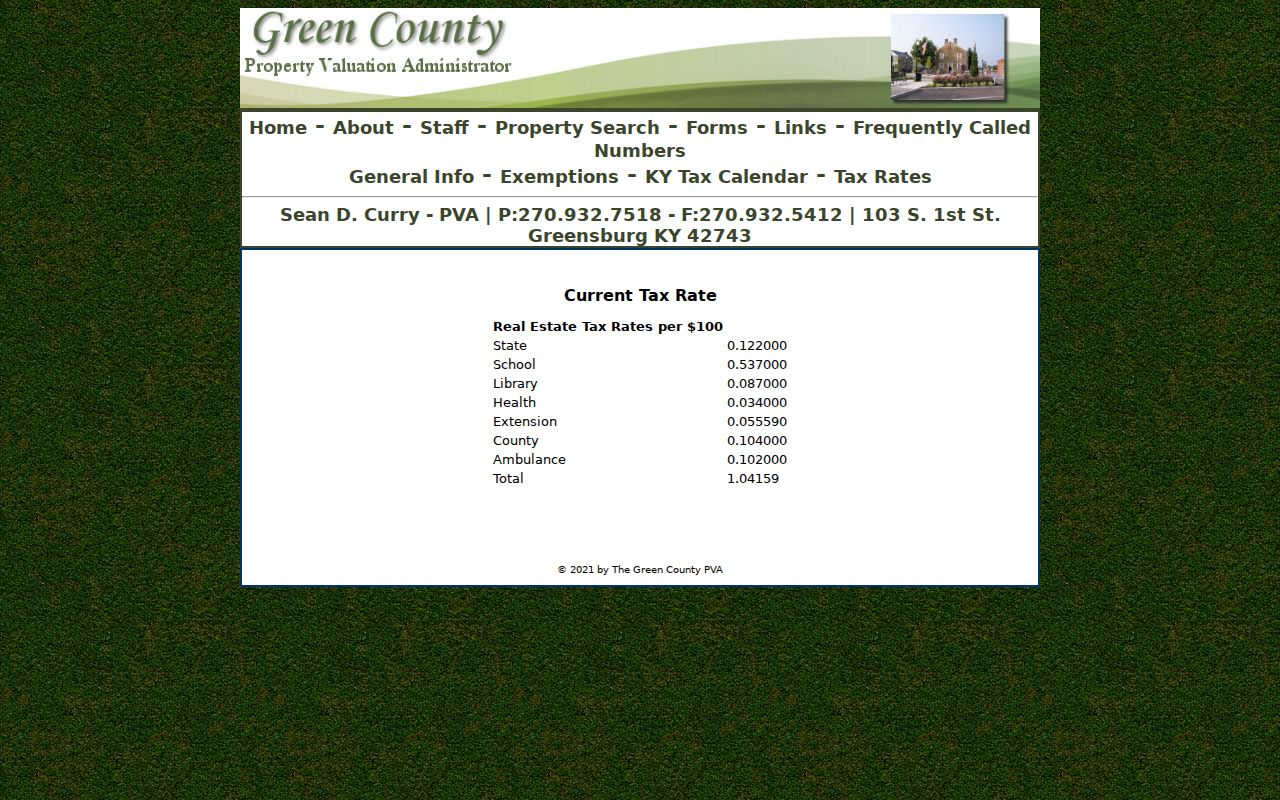
The published total is 1.041590 per $100. Your parcel's year, district, taxable assessment, and exemptions still control the math. Check the current rate page before calculating. For balances and receipts, ask the sheriff; the PVA value screen does not carry them.
Prepare Evidence When a Value Appears Wrong
During the annual inspection period, a taxpayer may confer with the PVA. If that goes nowhere, state guidance calls for filing with the county clerk by one working day after inspection ends. A local board process follows. A further appeal to the Kentucky Board of Tax Appeals is possible, so verify the current year's dates and Green County form route before acting. Good evidence includes the full PVA card, recent arm's-length sales, photographs, repair estimates, correct acreage and use, building details, farm classification, and comparable nearby assessments. A neighbor's lower total alone proves little. Parcel sizes, structures, districts, exemptions, or assessment years may differ.
Test the Components Behind the Total
A total earns trust when its components show. Record land value, improvement value, and total assessed value. Also record acreage, property class, building characteristics, farm designation, exemption, and assessment year. If the card shows one combined figure or an unfamiliar label, preserve the wording. Ask the PVA what it includes. New construction can lift the improvement component. Land may hold steady while buildings climb. Demolition, condition problems, or an acreage correction moves some pieces. A split, consolidation, or a use change moves the pieces differently. Agricultural value reflects qualifying treatment. Do not compare it flatly with a residential or commercial tract. The PVA's role has limits. Public-service companies, bank shares, and some omitted tangible property use other systems. So do vehicles assigned to Frankfort. The local real-property card may not list every taxable asset. Not every asset tied to an owner or address appears there.
Read Sale Evidence Before Using It as a Benchmark
A qPublic transfer panel, when available, lists a date, amount, and deed reference. Those fields point to the instrument, not replace it. Retrieve the clerk's image. Check the parties' capacities, consideration, tax stamps, legal description, conveyed interest, exceptions, prior deed, and whether several parcels were included. Family conveyances, gifts, and estate distributions often mislead. Correction deeds, survivorship instruments, foreclosure deeds, and undivided-interest transfers are no better. An ordinary sale can still bundle personal property or multiple tracts. Label the figure as deed consideration. Call it a sale price only when the context supports that. Master Commissioner appraisals and sale notices serve litigation. A notice may list an address, civil action, map number, source of title, appraisal, and bid terms. None of that is the PVA assessment. It is not a guarantee of proceeds either. Follow the case and its recorded outcome before treating a scheduled sale as a completed market event.
Build a Reproducible Green County Comparison
A defensible comparison needs careful notes. For each figure, record the source, the assessment or transaction date, the exact field label, the parcel ID, and any disclaimer the office attaches. Saving the retrieval date helps too. Laid side by side, one assessment-year total, a deed consideration, and a qualified appraisal can tell a coherent story. That story holds provided you explain why their dates and purposes differ.
Nearby parcels add another wrinkle. Municipal or special-district boundaries may quietly change the context, so confirm them first. City zoning, the PVA property class, and a deed restriction sit on three separate layers. A Greensburg permit can describe new work without moving the county assessment right away. A city address request never creates a legal lot. Whatever city material you gather, anchor it to the recorded plat, the deed, and the PVA card.
Dynamic records deserve a second look whenever a tax year turns over, construction wraps up, a transfer records, or a current figure is required. Save any qPublic refresh statement. A stale screenshot should never stand in for a live quote.
Recognize What Green County Assessment Cannot Prove
Know what a PVA figure cannot do. It cannot guarantee a selling price. It cannot promise a financing result, an insurance value, or a replacement cost. And it cannot vouch for clean title condition. A renovation, a storm, a parcel change, or a transfer after the snapshot may go unseen. A deed amount, though newer, still cannot prove present value on its own.
For a sale, an estate, lending, or litigation, get advice. Get a valuation built for that purpose. Tax questions about characteristics, classification, exemptions, and assessment belong with Green County PVA Sean D. Curry at 103 South/1st Street in Greensburg, 270-932-7518.
Value is not price. A Green County property value on the assessment roll is a public tax-administration figure, not a promise of what a buyer will pay. A licensed appraisal provides a separate opinion for a stated date and purpose.